Aged Care Workers in Australia Face Rising Injury and Assault Rates
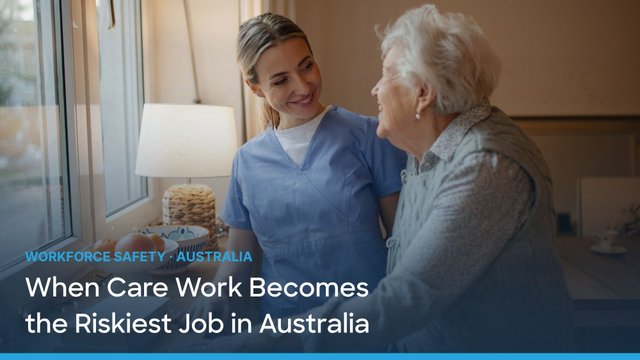

Aged Care Employee Day earlier this month (7 August) came with a hard number from the Australian Institute of Health & Safety (AIHS) that's worth sitting with well beyond the day itself: the workforce caring for our parents and grandparents is being injured and assaulted at rates the rest of the working population never sees. Aged care workers are assaulted on the job at 6.5 times the rate of any other occupation, and serious mental health compensation claims in the sector have almost doubled over the past decade. For providers preparing to grow their aged care and community care footprint in Australia, this isn't just a sobering headline, it's a workforce risk that needs a system behind it, not just good intentions.
We're covering this because it sits squarely in the middle of what GetHomeSafe exists to solve. We build lone worker safety technology for healthcare, community care, and other high-risk sectors across Australia, New Zealand, Canada, the US and the UK, and aged care is one of the clearest examples of a workforce that is isolated, physically at-risk, and under-supported by the manual processes most organisations still rely on. When a national industry body puts hard numbers behind that risk, it's worth unpacking what those numbers actually mean for the safety systems providers have in place.
What did the AIHS say, and why does it matter?
To mark Aged Care Employee Day on 7 August, AIHS Chair Celia Antonovsky called on employers and regulators to do more to protect the roughly 456,000 aged care workers currently supporting around 1.3 million older Australians across residential aged care, home care, retirement living, and seniors' housing. The day itself has passed, but the data behind it hasn't gone anywhere, if anything, it's a useful look at what's actually changed in your organisation's approach to worker safety, not just what was said on the day.
The release drew on Safe Work Australia data to highlight two figures in particular:
- Assault rates 6.5 times higher than any other occupation, driven by aggression, intimidation, and verbal abuse from clients and residents.
- Serious musculoskeletal injury claims at 2.3 times the national average, largely from the physical demands of lifting, moving, and supporting people in care.
Ms Antonovsky was direct about the flow-on effect: high injury rates contribute to burnout, rising workers' compensation claims, staff shortages, and experienced workers leaving the sector altogether, at the exact moment Australia's ageing population means demand for aged care workers is only going up.
Why is the risk profile for aged care so different?
Safe Work Australia's WHS profile of the nursing, care and support workforce (which includes aged and disabled carers alongside nurses and personal care workers) backs this up with more detail than the media release alone captures:
- Aged and disabled carers work in roles where being assaulted by a person or persons is one of the leading causes of serious "body stressing" claims, a category that also includes injuries from restraining or repositioning a resident during an incident.
- Over half (54.5%) of body stressing claims in this workforce name another person, usually a patient or resident, as the direct cause, compared with just 12.8% across all other occupations.
- Mental health conditions, particularly anxiety and stress disorders, reactions to stressors, and PTSD, now account for a large and rising share of serious claims, consistent with the near-doubling AIHS flagged.
- The workforce is 85% female, works longer average hours than the national workforce, and skews toward roles, night shifts, home visits, single-carer shifts, where a worker is often the only staff member present when something goes wrong.
That last point is the one that matters most for how providers actually manage the risk. Injury and assault statistics describe what happens to aged care workers. They don't capture how alone many of those workers are when it does.
What does this mean for aged care providers entering or growing in the Australian market?
For any organisation preparing to operate in Australia's aged care sector, the AIHS data lines up with a pattern we see consistently across the healthcare and community care teams we work with: the highest-risk moments happen when a worker is on their own. It's the same pattern that shapes how we build GetHomeSafe, and it's why this particular release stood out to us rather than the many other workplace safety statistics released each year.
That includes:
- Home and community care visits, where a single carer enters a client's home with no colleague present and limited visibility into the client's mood or history before arriving.
- After-hours and overnight shifts in residential facilities, where staffing is at its thinnest and an incident is least likely to be noticed quickly.
- Personal care tasks, showering, transferring, repositioning, that combine the physical risk of manual handling with the unpredictability of a resident who may be agitated, confused, or resistant to care.
- Lone travel between visits, often on regional roads where mobile coverage isn't guaranteed.
Person conducting a business or undertaking (PCBU) obligations under Australian WHS law already require providers to identify these hazards and put controls in place. The AIHS release is effectively a public reminder that "we've always done it this way", informal buddy systems, text-based check-ins, or relying on a worker to call if something goes wrong, is no longer holding up against the scale of the risk.
It's worth asking where those gaps sit in your own organisation before they show up in a claim. If it's useful to talk through what that looks like for your rosters and locations, you're welcome to book a time with our team.
How does lone worker monitoring address the specific risks AIHS flagged?
This is precisely the gap purpose-built lone worker safety platforms are designed to close, and it's why it's directly relevant to aged care and community care providers assessing their WHS systems:
- Automated check-ins for every visit or shift. Rather than relying on a worker to remember to call in, a timed check-in prompts the worker directly, and escalates automatically the moment it's missed, no one has to be watching a dashboard.
- Discreet duress alerts for the moments AIHS describes. When a resident or client becomes aggressive or intimidating, calling out for help isn't always safe. A silent panic alert, triggered from a phone or a small wearable button, sends the worker's live location and context to a nominated responder without escalating the situation further.
- Hazard flagging tied to the person, not just the address. Workers can log known risks, a history of aggression, an unpredictable client, a property with poor lighting or access, so that whoever responds to an alert has the full picture immediately, not after several phone calls.
- Coverage that doesn't stop when the shift does. After-hours, overnight, and low-coverage regional visits are exactly when manual processes fail and when many of the incidents behind these statistics occur.
None of this replaces training, rostering, or clinical risk assessment. What it does is close the specific gap the AIHS release points to: when something goes wrong for a worker who is alone, how quickly does anyone find out, and how much context do they have when they do?
A practical starting point
Providers reviewing their lone worker safety processes ahead of growth into new markets don't need to overhaul everything at once. A useful first step is auditing where check-ins currently rely on a worker remembering to text or call, where duress situations have no silent way to raise the alarm, and where after-hours or regional visits fall outside normal monitoring altogether. Those three gaps are consistently where the risk described in the AIHS release turns into an unmanaged incident.
Want a structured way to run that audit?
Download the free lone worker safety checklist
Aged Care Employee Day is designed to say thank you to the people doing this work. The AIHS data is a reminder that saying thank you and making sure they come home safe aren't the same thing, and the second one is where we focus.
Frequently asked questions
According to Safe Work Australia data cited by the AIHS, aged care and nursing, care and support workers experience serious workers' compensation claims for assault at 6.5 times the rate of all other occupations.
Manual handling tasks, lifting, transferring, and repositioning residents or clients, account for the largest share of serious claims in the sector, with claim rates 2.3 times the national average. More than half of these "body stressing" claims involve another person, usually a resident, as the direct cause.
Aged care work regularly involves a single carer working without a colleague present, during home visits, overnight shifts, or one-on-one personal care, combined with a documented risk of aggression and physical injury from the people in their care. That combination of isolation and elevated risk is exactly what lone worker monitoring is designed to cover.
Both. Home care workers are alone for the entire visit with no colleague nearby. Residential facility staff face the same isolation during overnight and after-hours shifts when staffing is at its lowest and a single carer may be responsible for an entire wing or floor.
See how this applies to your team
Visit the healthcare & community page to see how GetHomeSafe is built for the specific risks aged care and home care teams face, or book a demo to walk through how it would look for your own team.
Sources
- Australian Institute of Health & Safety, Media Release: Aged Care Employee Day — Aged Care Workers Face Alarming Injury and Assault Rates, 7 August 2026
- Safe Work Australia, WHS Profile: Nursing, Care and Support Workforce
- Department of Health, Disability and Ageing, Financial Report on the Australian Aged Care Sector 2023–24
- Ageing Australia, Aged Care Employee Day
Published: 31st August 2026