Why SMS Fallback Is Changing the Game for Remote Worker Safety
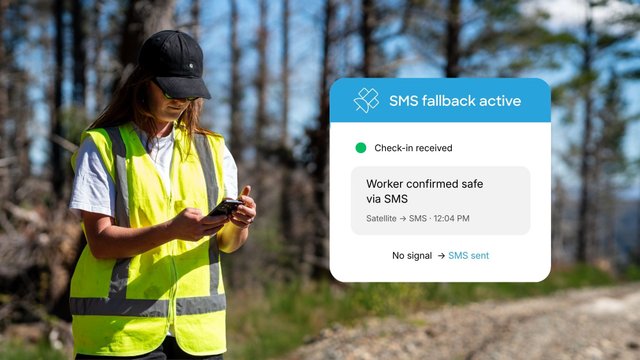

It's 3:47 pm. One of your field workers is carrying out a routine inspection on a remote stretch of infrastructure, kilometres from the nearest town, well beyond the reach of any cell tower. They were supposed to check in 20 minutes ago.
Without connectivity, you have no way of knowing whether they're fine or whether something has gone wrong. No check-in. No location. No signal. Just silence, and the uncomfortable question of how long you wait before raising the alarm.
This scenario has played out thousands of times across industries worldwide. Until very recently, it was simply the reality of managing remote teams: the moment someone moved beyond cell coverage, you lost all visibility of them. The only workaround was issuing dedicated satellite devices, separate hardware with its own data plans, charging requirements, and interfaces that were often confusing or cumbersome for workers to use alongside their everyday phone. Adoption was inconsistent, costs were high, and for many organisations it simply wasn't practical to equip every remote worker with a second device.
Satellite-to-mobile changes that entirely. The phone your workers already carry in their pocket is now the satellite device. No extra hardware. No additional setup. No confusion. And when paired with SMS fallback, it means critical safety communications can get through from virtually anywhere.
That shift is happening right now, and it's happening fast.
Key takeaways
- Satellite-to-mobile (STM) technology allows standard smartphones to communicate via orbiting satellites when cell coverage isn't available, no extra hardware required.
- SMS fallback is the mechanism that ensures critical safety messages, check-ins, alerts, HomeSafe notifications, still get through when a full data connection isn't possible.
- Together, STM and SMS fallback mean workers are reachable beyond cell coverage without specialised equipment for the first time, closing what has been the single biggest gap in remote worker safety.
- Organisations can strengthen their duty of care by demonstrating real-time safety monitoring even in off-grid environments.
- GetHomeSafe supports both satellite data and SMS fallback, so essential safety events are delivered regardless of connectivity conditions.
What is satellite-to-mobile?
Satellite-to-mobile (sometimes called direct-to-cell or direct-to-device) is exactly what it sounds like: your everyday smartphone connecting directly to satellites in orbit, without any specialised hardware, bulky antennas, or separate satellite devices.
Traditional satellite communication has always required dedicated phones, expensive, proprietary handsets that cost upwards of $500. They worked, but they were a barrier. Most organisations couldn't justify issuing every remote worker a satellite phone alongside their regular mobile.
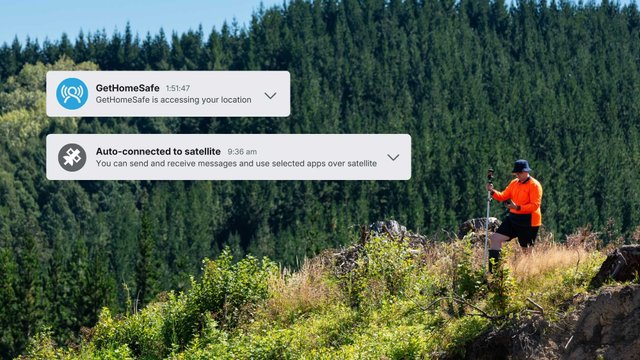
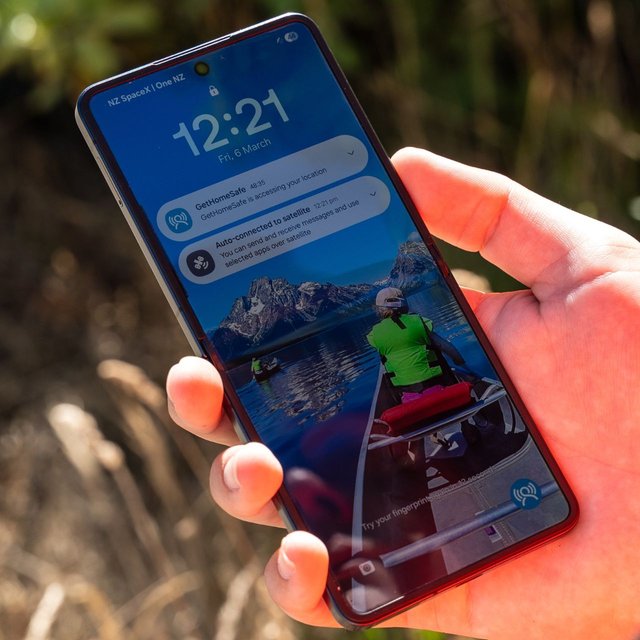
Satellite-to-mobile changes that equation entirely. Powered by low-earth orbit (LEO) satellite constellations, most notably SpaceX's Starlink network, the technology allows compatible smartphones on supported mobile plans to send and receive messages via satellite when they move out of terrestrial cell coverage. Your phone detects that it's lost connection to a cell tower and automatically attempts to route communications through an overhead satellite instead.
The rollout is accelerating globally. T-Mobile in the United States, One NZ and Spark in New Zealand, carriers across Europe, Japan, and Australia are all either live or in advanced stages of deployment. Samsung, Apple, and Google have all built satellite communication capabilities into recent smartphone models. This isn't a niche feature any more, it's becoming standard mobile infrastructure.
See satellite-to-mobile in action, watch how it works in the video below.
Want to know how this could work for your team? Keep reading, or get in touch any time at sales@gethomesafe.com.
What is SMS fallback and how does it work?
Here's the thing about satellite-to-mobile: the satellite data connection is powerful, but it isn't always available in every situation. Satellite bandwidth is limited compared to 4G or Wi-Fi connection. Conditions like heavy tree cover, narrow valleys, or even weather can affect signal strength. And the technology is still maturing, coverage is expanding rapidly, but it's not seamless everywhere just yet.
This is where SMS fallback comes in.
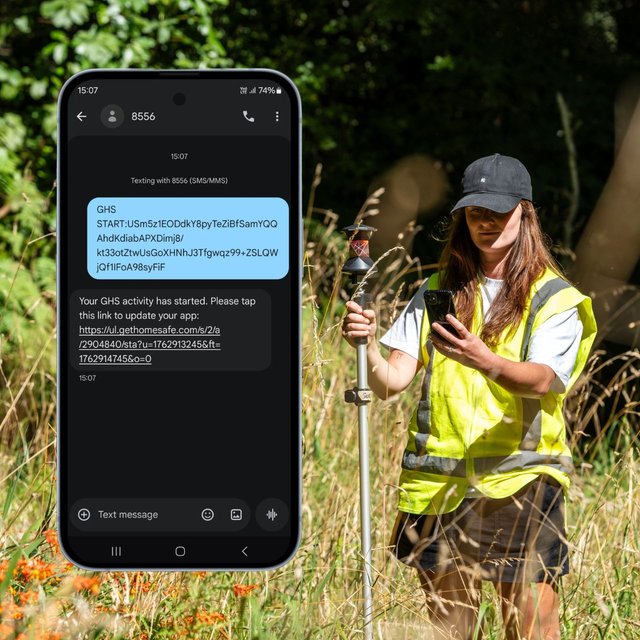
SMS fallback is the safety net beneath the safety net. When a full satellite data connection isn't possible, GetHomeSafe automatically falls back to SMS, including satellite-delivered SMS on compatible devices and plans, to ensure that the most critical safety messages still get through.
GetHomeSafe uses a layered approach to connectivity:
- First preference: standard mobile data (4G/Wi-Fi). When available, everything runs as normal, full app functionality, live location sharing, rich check-ins, risk assessments, and more.
- Second layer: satellite data. When cell coverage drops out, the phone connects via satellite and GetHomeSafe continues to operate with full functionality on compatible devices and plans.
- Final layer: SMS fallback. If even satellite data isn't available or is too constrained, GetHomeSafe falls back to SMS (including satellite SMS) to deliver essential safety events, OK check-ins, HomeSafe confirmations, and help and emergency alerts, using minimal bandwidth.
The beauty of SMS is its simplicity. An SMS message requires a fraction of the bandwidth that a data connection does. It's lightweight, resilient, and has been the backbone of mobile communication for decades. When it comes to safety, you don't need a rich data stream, you need confirmation that someone is okay, or notification that they're not. SMS is perfectly suited for that.
This layered approach means GetHomeSafe doesn't rely on any single connectivity type. It uses whatever is available, mobile data first, then satellite data, then SMS, so that critical safety events reach their destination regardless of where your workers are.
Why does SMS fallback matter for remote worker safety?
SMS fallback isn't a nice-to-have. For organisations with people working in remote, rural, or off-grid environments, it's the difference between maintaining visibility of your workers and losing it entirely.
It keeps workers reachable beyond cell coverage
This is the fundamental shift. Historically, the moment someone moved out of cell range, they disappeared from your safety system. You couldn't check in on them. They couldn't reach you. If something went wrong, an injury, a vehicle breakdown, a medical event, it could be hours before anyone even knew there was a problem. Often, the first sign of trouble was simply that the worker didn't arrive home that evening.
With SMS fallback, critical safety events still get delivered. Workers can still complete check-ins. Managers still receive HomeSafe notifications. Emergency and duress alerts still reach the people who need to act on them. The coverage gap that has defined remote work safety for decades is closing.
It strengthens your duty of care
Every employer has a legal and moral obligation to take reasonably practicable steps to protect the health and safety of their workers. For organisations operating in remote environments, a recurring challenge has been demonstrating that you've maintained oversight of workers who are beyond the reach of conventional communication networks.
SMS fallback changes the conversation. It allows organisations to demonstrate real-time safety monitoring even beyond standard cell tower coverage. That's a meaningful shift in how duty of care can be met, and evidenced, for remote workers.
It reduces the cost of getting it wrong
When safety systems fail silently, when there's simply no data because there's no coverage, the consequences are measured in delayed response times. Minutes become hours. A missed check-in that should trigger an immediate welfare call becomes a growing uncertainty that isn't resolved until someone physically drives out to locate the worker.
SMS fallback compresses that timeline. A panic alert sent via SMS reaches the monitoring dashboard in near real-time. An overdue check-in triggers escalation procedures that can begin immediately, not hours later when the worker is expected home.
It improves system adoption
One of the biggest challenges with any safety technology is getting workers to actually use it consistently. When people know there are large areas where the system simply won't work, adoption suffers. Workers start leaving the app, skipping check-ins, or reverting to informal "text your mate" arrangements that provide no organisational oversight.
When the system works everywhere, when workers don't need to think about whether they're in coverage, adoption improves. It becomes a habit rather than a sometimes-tool.
Exploring how to close coverage gaps for your team? Book a demo today to talk through your options.
Book a demoWho needs satellite-to-mobile and SMS fallback?
If your people work in environments where cell coverage is inconsistent, limited, or non-existent, this technology is directly relevant to you. That includes, but isn't limited to:
- Utilities and infrastructure: Line workers, technicians, and inspectors operating across power, water, and telecoms networks that extend well beyond urban coverage.
- Forestry and conservation: Workers in dense bush, national parks, or remote conservation estates where coverage is minimal or absent.
- Agriculture and primary industry: Farm workers, contractors, and rural teams operating across large, isolated properties.
- Mining and resources: Remote site workers, geologists, and field teams in locations where terrestrial infrastructure doesn't exist.
- Construction and civil works: Teams on remote road, rail, and infrastructure projects, often in areas with patchy or no coverage.
- Healthcare and community services: Community nurses, social workers, and outreach teams visiting isolated properties or travelling long distances between appointments.
- Transport and logistics: Drivers covering long-haul routes through remote corridors with significant coverage dead zones.
- Land and environment: Rangers, environmental scientists, surveyors, and anyone working in backcountry or coastal environments.
- Not-for-profit and NGOs: Field teams operating in underserved or remote regions, often with limited infrastructure.
The common thread is simple: if your workers go places where phones don't normally work, satellite-to-mobile and SMS fallback exist to make sure your safety system still does.
What can GetHomeSafe still do with SMS fallback?
GetHomeSafe is designed with a layered approach to connectivity. When satellite data is available, the full platform runs as intended, detailed work and journey plans, risk assessments, live location sharing, man-down alerting, and everything in between.
When conditions require it, SMS fallback ensures that the most critical safety events are still delivered. Through SMS (including satellite SMS on supported devices and plans), workers can still:
- Complete OK and welfare check-ins — confirming they're safe and on track.
- Send HomeSafe notifications — letting the system and their contacts know they've finished for the day and arrived home safely.
- Trigger help and emergency alerts — raising the alarm when something goes wrong, with the alert delivered to the right people immediately.
These aren't stripped-back or reduced-functionality features. They're the core safety events that matter most, the ones that confirm someone is okay, or tell you they're not.
It's worth emphasising: satellite data connectivity works automatically within GetHomeSafe, no changes to your account are required. SMS fallback is available as an additional capability that can be enabled for your organisation on request. Get in touch with our team to have it switched on and discuss how it fits your setup.
Want more information on GetHomeSafe satellite-to-mobile or SMS fallback capabilities? Talk to us today and we can discuss any questions you have.
Talk to us
Frequently asked questions
Satellite-to-mobile is the broader technology that allows a standard smartphone to connect to orbiting satellites when cell coverage isn't available. SMS fallback is a specific mechanism within that, it's the system's ability to fall back to SMS messaging (including satellite-delivered SMS) to ensure critical safety events are still delivered when a full data connection isn't possible.
No. SMS fallback works on compatible standard smartphones with a supported mobile plan. There's no need for a dedicated satellite phone, external antenna, or any additional device. The satellite connectivity is built into the phone and the carrier network.
The most critical safety events: OK and welfare check-ins, HomeSafe notifications (confirming a worker has finished safely), and help and emergency alerts. These are the core events that maintain visibility of worker safety when conditions are challenging.
SMS is one of the most resilient forms of mobile communication. It requires minimal bandwidth, has decades of proven reliability, and is designed to get through in low-signal conditions where data connections would fail. For safety-critical messages, which are typically short, text-based confirmations or alerts, SMS is ideally suited.
Satellite data connectivity is included in GetHomeSafe at no additional cost. SMS fallback is available as an additional capability, contact our team to discuss enabling it for your organisation. In both cases, you'll need a current version of the GetHomeSafe app on a compatible device with a mobile plan that supports satellite features. Check with your mobile carrier for plan details.
Satellite-to-mobile services are live or rolling out across the United States, Canada, New Zealand, Australia, and much of Europe, with further expansion planned. Coverage depends on your mobile carrier and device. The technology is expanding rapidly and new markets are coming online regularly.
Satellite connectivity generally requires a reasonable view of the sky. In heavy forest canopy, the signal may be reduced. However, SMS requires far less signal strength and bandwidth than a full data connection, so it can often succeed in conditions where data would not. Workers in dense environments should look for open sky when sending critical messages.
The coverage gap is closing. Is your safety system keeping up?
No cell coverage has been the single biggest limitation for remote worker safety since the industry began. Satellite-to-mobile and SMS fallback are removing that limitation, not in theory, not eventually, but right now.
GetHomeSafe has been building for remote work since 2017. Our platform is designed for the environments your people actually work in: rural, rugged, isolated, and often beyond the reach of cell towers. Satellite-to-mobile and SMS fallback are a natural extension of what we've always done, making sure every worker can get home safely from every shift.
Whether you're already exploring satellite-to-mobile or just starting to ask the right questions, we're happy to talk it through.
See what it looks like for your team
Book a demoGetHomeSafe is a workplace safety platform trusted by organisations across New Zealand, Australia, Canada, the UK, and the US. Learn more about how it works.
Last Updated 16th July 2026